William Kentridge
Artist Bio
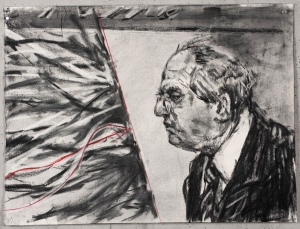
William Kentridge’s expansive studio practice of charcoal drawing, printmaking, theater, film, opera, sculpture, and many other mediums is rooted in South Africa. Kentridge was born in 1955 and grew up in Johannesburg, in a family of anti-apartheid lawyers and activists. Throughout his lifetime, he has experienced his home country move from the systemic oppression of its Black majority and other groups, both before and after an apartheid government, to a turbulent present in which the aftermath of colonialism continues to impact South African lives.
Kentridge began making art in earnest in the 1980s, when opposition to apartheid, after decades of suppression, further erupted into protest and violence. During this period, as a student at the University of the Witwatersrand, Kentridge initially majored in politics, dividing his time between his studies, art making, and work at an interracial theater troupe, the Junction Avenue Theatre Company (“JATC”). Employing methods that inform Kentridge’s practice to this day, the troupe sought to use a workshop spirit to work through and resist the “madness of apartheid,” as well as to tell colonial histories from the perspective of the colonized.
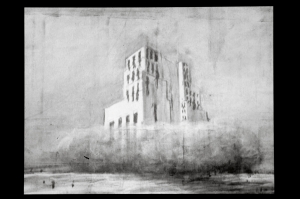
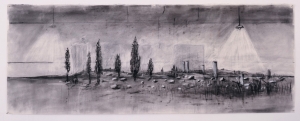
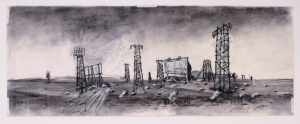
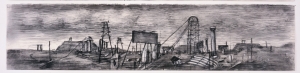
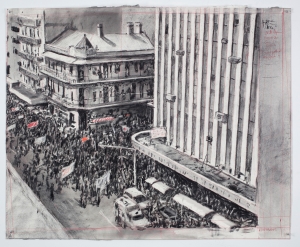
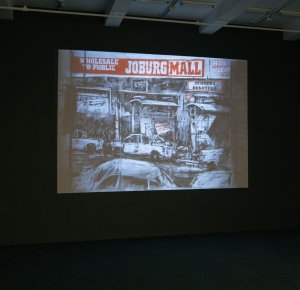
While with JATC, Kentridge produced prints and drawings that engaged the physical and psychic landscapes of Johannesburg, focusing on the gold-mining industry’s effects on the origins of the city and its inequalities. Kentridge’s work not only exposed relics of the industry scattered across the terrain but also investigated how mining actively supported the racial segregation of neighborhoods, promoted vast disparities of wealth, and laid the groundwork for apartheid long before it was officially legislated.
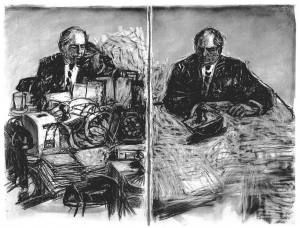
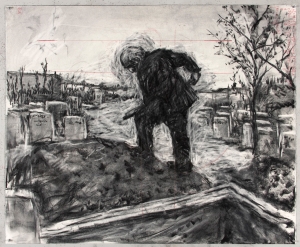
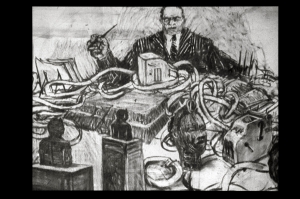
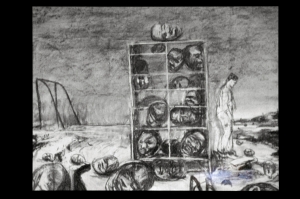
In 1989, Kentridge released the film Johannesburg, 2nd Greatest City After Paris, the first of his series Drawings for Projection, now totaling eleven works. In the films, the artist created an alternative form of animation by drawing, erasing, and redrawing charcoal images. Following the life of a fictional mining magnate named Soho Eckstein, Kentridge looked to contemporary events in South Africa through the lens of its painful and ever-present past.
Since 2010, his main studio has been located on the property of his childhood home in the suburb of Houghton. From this base, he pursues multiple trajectories of art making. His solitary pursuit of charcoal drawing intermingles with and is expanded by collaborations in theater and set design, filmmaking, bronze casting, printmaking, and music.
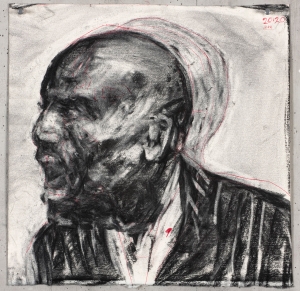
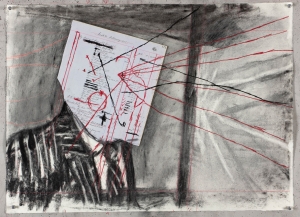
Kentridge often speaks of trusting the activity of making, using the act of drawing, or engaging with other physical mediums, to loosen up and release energies of the mind. Kentridge’s movements inside of his studio become what he likens to a minimalist theater—with the artist walking, pacing, thinking, and generally moving in relation to works in process. He is open to surprise, uncertainty, and unexpected connections. He collects an inventory of images and associations, which migrate through multiple bodies of work.
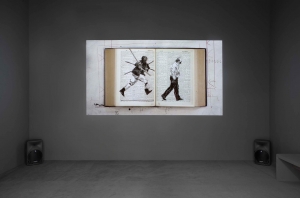
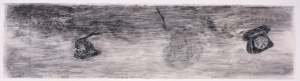
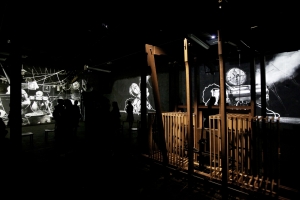
Growing out of conversations between Kentridge and Harvard physicist Peter Galison, The Refusal of Time (2012) combines drawing, film, sculpture, and performance. The installation concerns the history of measurement, specifically the push in the wake of the French Revolution to organize space and time according to universal standards. Between this period and Albert Einstein’s Theory of Relativity (which found time to be variable according to position and the speed of light), the rush to codify time was often connected with the desire of colonizing nations to have instantaneous communication with (and control over) their colonized interests around the world.
Running against the grain of this drive toward certainty, Kentridge presents films that seek to make time visible, grounded in the body versus cultural mandates. United by music and sound environments created by Philip Miller, five interrelated films are projected around a large sculpture called the “elephant.” Based on French clocks that used compressed air to sync through a series of connected tubes, the sculpture inflates and deflates like a human lung, mapping time on the individual level. Kentridge wrote of the project:
The project "Refusal of Time" began with considerations of different kinds of time, but as the work progressed it became clear that it was as much about FATE as about TIME; and our attempts to escape from that which insists on what and how and where we are. But there was more than that. There was a hope that if I started with the practical activities of design of sets, costumes, musical instruments, machinery, the direction and thrust of the lectures could be changed to a path I had not taken before—as if I could change not just their trajectory but their final destination.